
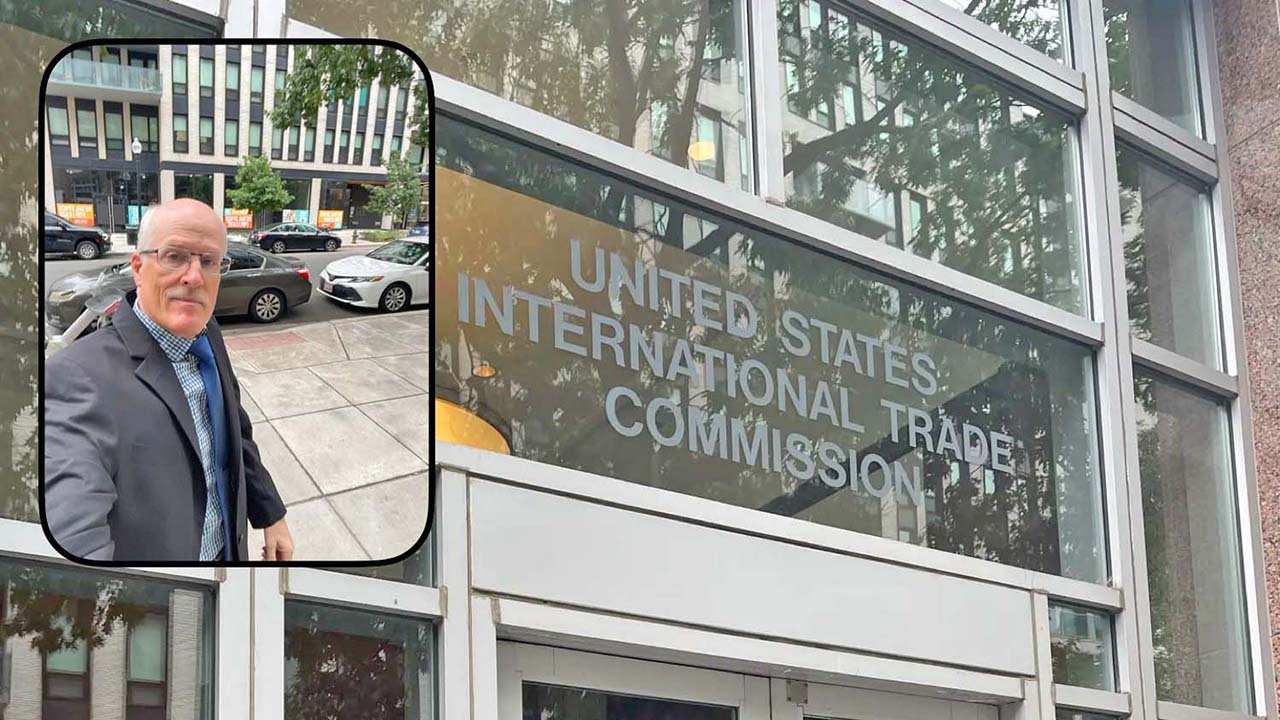
As part of the second Trump administration reindustrialization policy, it invoked the International Emergency Economic Powers Act (IEEPA) to impose universal baseline duties across trading partners at the beginning of 2025. Then a February 2026 U.S. Supreme Court ruling struck down IEEPA as an authority for general tariffs. So, the Administration pivoted to Section 122 to enact temporary balance-of-payments duties. Since Section 122 duties expire after 150 days (July 24, 2026), new Section 301 investigations into foreign supply chains and forced labor were started at the same time. Section 301 requires public hearings as part of the investigation process and euroSource choose to provide both oral and written testimony because the Administration’s trade policy has been particularly damaging to small businesses that sell imported product with no possible alternate source.
The hearing, titled “Failure to Impose and Effectively Enforce a Prohibition on the Importation of Goods Produced with Forced Labor”, turned out to be only very marginally public. There was no livestream, no TV coverage, no recording devices allowed, and only a written transcript available after the completion of each day. So only the “public” able to physically be in the hearing room were accommodated – a miniscule percentage of the public.
My oral testimony follows:
Good afternoon. My name is Randall Hertzler, and I am the owner of euroSource LLC, a small business in Lancaster, Pennsylvania. I would like to briefly describe the path that brings my company to this hearing. It illustrates the increasingly difficult environment many small businesses face.
Since 1999, euroSource has imported specialty toys and educational products manufactured in Europe with no U.S. equivalent and no alternative source of supply. Then, in 2008, the Consumer Product Safety Improvement Act, had the unintended consequence of penalizing low volume European brands in favor of those mass produced in Asia. Over subsequent years, our supply thinned. Today, we import one remaining specialty product, Ankerstein building stone sets, manufactured in Rudolstadt, Germany since the 1880s.
Starting in 2025, tariffs increased our landed costs. In August of 25, the elimination of de minimis treatment, more than doubled our logistics costs and we lost access to low-cost transport options. These place unprecedented pressure on our business.
Throughout, I engaged with Congressman Smucker’s office and later with the USTR Office of Intergovernmental Affairs and Public Engagement. USTR asked our small-business coalition to identify HTS classifications that might merit relief. We provided an HTS list, but it eventually became clear that product-by-product relief through these classifications was unlikely to provide a workable solution. For this reason, we focus on a two-pronged approach to address tariffs and large increases in logistics costs.
That brings us to today’s proceeding.
The Federal Register requests comments on the proposed responsive action in the Section 301 investigations related to the failure to impose and effectively enforce a prohibition on the importation of goods produced with forced labor. While the European Union is implementing its regional Forced Labour Regulation, Germany established a comprehensive system through its Supply Chain Due Diligence Act in June 2021. By placing the EU as a whole into the 10% tariff tier, based on a “failure to effectively enforce”, the proposed methodology fails to account for rigorous, independent enforcement already operating in member state Germany. The German Federal Office for Economic Affairs and Export Control actively audits companies, investigates complaints, and enforces compliance. Because Germany has NOT failed to impose and effectively enforce, euroSource recommends that USTR distinguish them from the broader EU and assign German imports a 0% Section 301 tariff rate.
These tariff considerations also highlight the importance of differentiating between, economy-level tariff policy, and transaction-level tariff implementation. euroSource recommends creating a commercial de minimis to complement the proposed tariff structure. Unlike product-specific tariff exclusions already explored with the USTR, commercial de minimis would apply only to low-value commercial shipments. It reduces unnecessary customs and logistics costs, and restores access to lower-cost shipping options. This provides targeted relief for legitimate small-business imports while preserving the policy goals behind ending broad de minimis last year.
These two recommendations are complementary. One appropriately calibrates tariff treatment at the economy level based on demonstrated efforts to combat forced labor. The other provides a practical transaction-level mechanism that advances the same trade policy objectives and restores vital low-cost logistics infrastructure for American small businesses.
Thank you for the opportunity to present my testimony. I welcome any questions.
I was asked a single question by Ms. Julia Reinitz of the Department of Labor:
In your testimony, you request USTR to apply materially lower tariff rates to certain economies like Germany that you claim have a long and active history of combating forced labor. And you suggested in your testimony that perhaps Germany should receive a tariff rate of zero percent because of their supply chain due diligence law. Could you expand on, in your opinion, more about how USTR might consider applying materially lower tariff rates based on other types of benchmarks in terms of an economy’s actions to combat forced labor? Noting, for example, that Germany’s supply chain due diligence law is not specifically a forced labor import prohibition, is not duplicative, for example, with the EU’s overall forced labor regulation.
In short, yes, Germany’s supply chain due diligence law is not specifically a forced labor law – it is what its title indicates. But part of supply chain due diligence is to remove any forced labor components that might be lurking there. This takes a proactive approach to removing forced labor from the economy.
You can find the written comments docket and three days of transcripts here: https://ustr.gov/trade-topics/enforcement/section-301-investigations/section-301-failure-impose-and-effectively-enforce-prohibition-importation-goods-produced-forced.